
Field Notes · A practical guide
Give the next thing a time.
The library book is due tomorrow. You remember it in the shower. Again on the bus. Excellent memory. Terrible places to return a book. When would it help to remember?
Give one reminder a job.
Pick something that keeps popping into your head today. If it’s “return the library book,” picture the first thing you could do about it. At home tonight, you could slip it into the bag you’ll take out tomorrow.
Open the alarm or reminder you already use. Pick a time when you expect to be near both the book and the bag. If you usually pack lunch at eight, try this as the label.
8:00 tonight — Put the library book in my lunch bag.
What would yours say?
Fill in this line for yourself: “At ___, I’ll ___.” Read it as though it just lit up your phone. Would you know what to reach for? Could you do it then?
“Laundry” might leave you doing the planning all over again. “Sunday at six — put the school shirts in the wash” gives you somewhere to start. If six is usually the middle of dinner, pick a time on the other side of it.
When it rings, notice what happens.
Eight o’clock. You’re packing lunch, the reminder pops up, and the book goes straight into your bag. One quiet heads-up did the job. If you’re still on the bus at eight, change the time. Even Amélie at her most dramatic can’t put a library book on that bus.
If you were home and the reminder barely registered, try changing how it gets your attention. In Ohlalarm, a Wink is the gentle heads-up. A Nudge is more like a friend at your elbow: “Got the book?” And if you want a proper send-off as you reach for your keys, there’s the Yell: “The book! It’s coming with you!”
You choose how much company you want. Keep just the Wink if it works. If packing the book and leaving with it are two moments when you’d like help, give each its own alert.
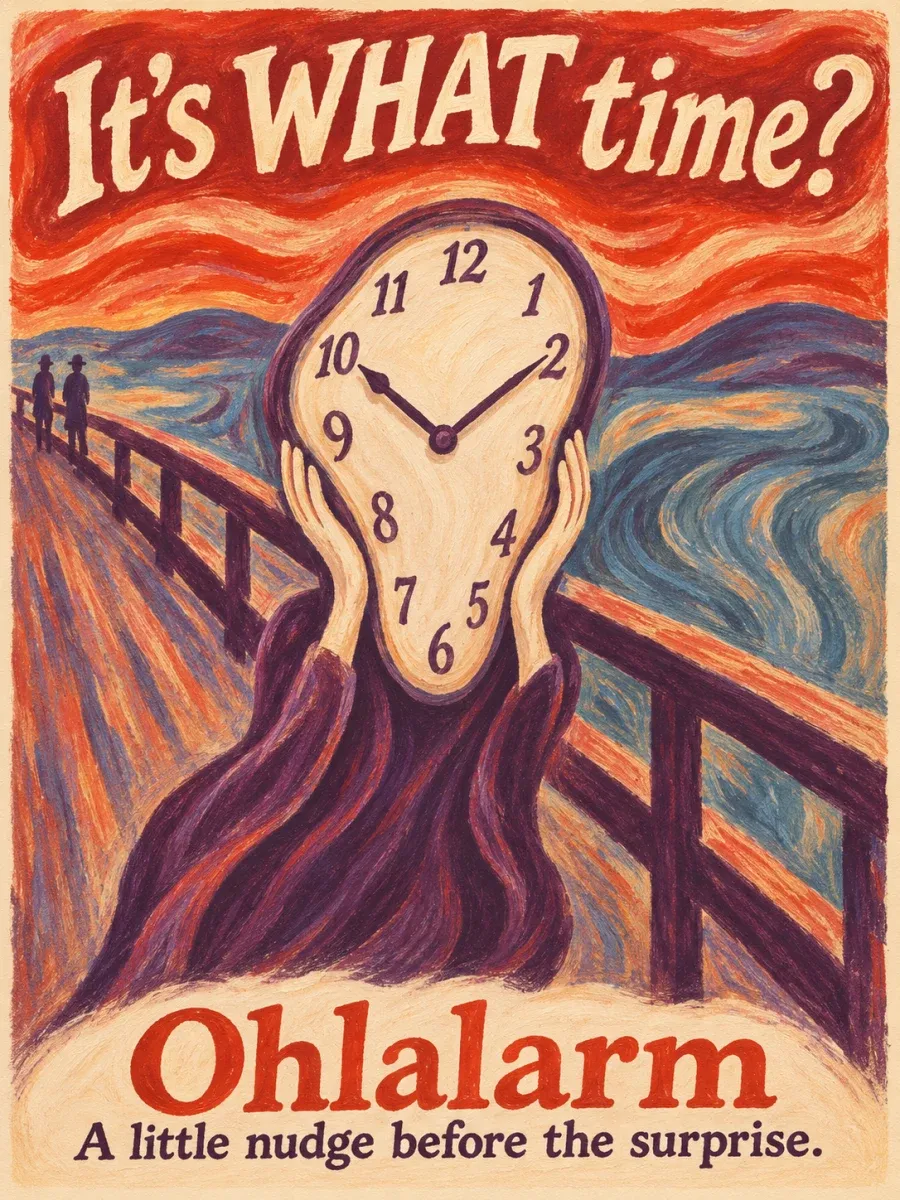
Why put the cue outside your head?
Think about what happens when you leave the book on top of your keys. Tomorrow, reaching for the keys brings the book to mind. You chose the cue tonight, while you remembered what you wanted to do.
Sam Gilbert tested a version of this idea with numbered circles on a screen. People who could move a circle ahead of time to remind themselves what to do later were more likely to carry out that intention. The link with remembering a separate real-life task was modest.
Ohlalarm gives you a way to leave that cue while the thought is fresh. Say or type, “At eight tonight, remind me to put the library book in my bag.” Amélie brings back a plan you can check: the time, the action and the alert. Adjust it if you like, then save. Now you can go back to dinner. She has the eight o’clock part.
What happens between now and then?
In a different set of experiments, people made specific plans for unfinished goals. During a later reading task, the unfinished business intruded less than it did for people who had written about unfinished goals without making plans. The researchers didn’t find corresponding relief from anxiety.
Neither study tested Ohlalarm. For your own reminder, a smaller question is easier to answer: did it catch you somewhere you could act?
Research and sources
- Sam J. Gilbert (2015). Strategic offloading of delayed intentions into the external environment.
Four online experiments on remembering to act later.
- E. J. Masicampo and Roy F. Baumeister (2011). Consider It Done! Plan Making Can Eliminate the Cognitive Effects of Unfulfilled Goals.
Experiments on specific plans, unfinished goals and attention during other tasks.
Back to your evening.
The book has an eight o’clock appointment with your bag. Until then, if someone at dinner is halfway through a good story, you get to hear the rest.
Meet Ohlalarm ↗